Google Cloud Network Security Integration (NSI) with VM-Series Firewalls
Table of Contents

Google Cloud Network Security Integration (NSI) with VM-Series Firewalls
Google Cloud’s Network Security Integration (NSI) enables traffic inspection for
existing Virtual Private Cloud (VPC) networks by steering or mirroring traffic to Palo Alto
Networks Software Firewalls without requiring changes to the underlying network
configuration. The in-line deployment model uses packet intercept to redirect traffic to the
software firewall for inspection, while the out-of-band deployment model uses packet
mirroring to send a copy of the traffic for analysis.
Google Cloud's Network Security Integration (NSI) with Palo Alto Networks®
software firewalls, including VM-Series Next-Generation Firewalls (NGFWs), addresses
common cloud security challenges. Traditional cloud security deployments often faced
complexities such as intricate routing, operational overhead, and VPC peering
limitations. This integration simplifies deploying advanced security services within
Google Cloud, ensuring consistent security policies and faster protection across
cloud infrastructure without altering your application architecture or existing
networking. It provides granular East-West traffic inspection, crucial for
preventing lateral threat movement, and Layer 7 network runtime security through
deep packet inspection, which controls applications, users, and content to protect
against sophisticated threats.
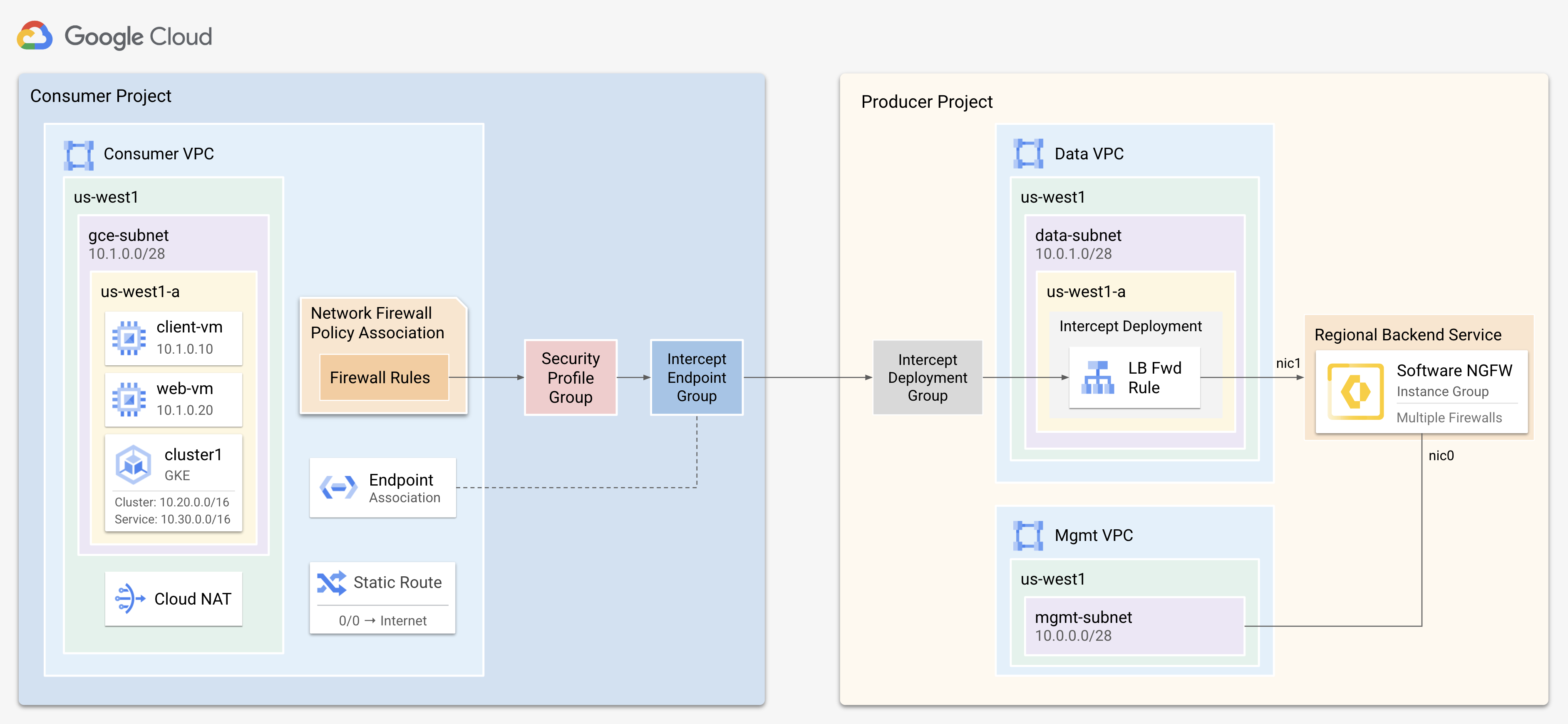
The NSI architecture operates on a producer-consumer model for scalable
security. In this model, security services (the producer) are deployed as a scalable
backend behind a Google Cloud internal load balancer, serving workloads (the
consumer). Key components include Palo Alto Networks® software firewalls with a load
balancer for advanced threat prevention and efficient traffic distribution, along
with Intercept Deployments and Endpoint Groups for security enforcement and policy
management. Geneve encapsulation is used to tunnel traffic to the firewall for
inspection without requiring extensive network modifications. Within the Geneve
packets, both the Security Profile Group ID (SPG-ID) and VPC ID are passed,
providing context for traffic.
NSI offers two primary modes:
- Inline (Packet Intercept) — Provides inline inspection for real-time threat prevention and blocking.
- Out-of-Band (Packet Mirroring) — Offers out-of-band monitoring for non-disruptive threat intelligence, compliance, and auditing.
Prerequisites
Before configuring the VM-Series firewall, ensure the following
prerequisites are met:
- Google Cloud Network Security Integration (NSI) Environment Setup:
- Fully provisioned and operational Google Cloud NSI environment.
- Producer and Consumer VPCs defined and interconnected.
- Intercept Deployments and Endpoint Groups configured and linked.
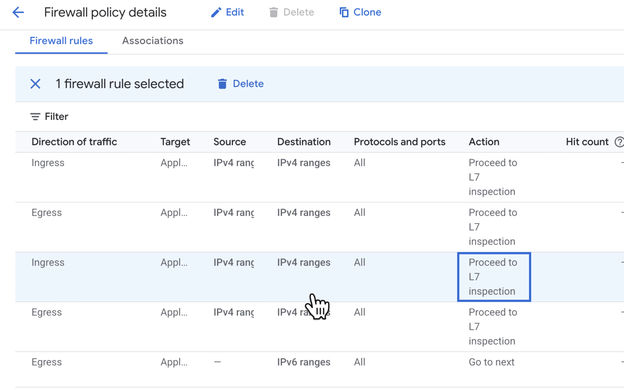
- Firewall rules in the Consumer VPC configured for Layer 7 redirection.
- Palo Alto Networks® VM-Series Firewall Deployment:
- A VM-Series firewall instance deployed within your Google Cloud Producer VPC.
Google Cloud Deployment (for VM-Series Firewall Configuration):
- Create a Security Profile Group.
- In GCP, go to Network Security Integration > Security Profile Groups.
- Click Create Security Profile Group.
- Define traffic inspection policies (For example: allow/block rules).
- Click Save.
This defines inspection criteria for intercepted traffic.Set Up Intercept Endpoint Group- Go to Network Security Integration > Intercept Endpoint Groups.
- Click Create Intercept Endpoint Group.
- Select the consumer VPC(s) whose traffic should be intercepted.
- Associate the relevant Security Profile Group.
- Click Save.
This links consumer VPCs to the security inspection pipeline.Create Intercept Deployment GroupIn the producer project:- Go to Network Security Integration > Intercept Deployment Groups.
- Click Create Intercept Deployment Group.
- Associate the previously created Intercept Endpoint Group.
- Specify load balancing details if needed (to direct traffic to VM-Series firewall).
- Click Save.
Deploy the Intercept Deployment- Go to Intercept Deployments.
- Click Create Intercept Deployment.
- Link it to the Intercept Deployment Group.
- Configure backend service/load balancer pointing to VM-Series firewall NICs.
- Save.
This step deploys the inspection service tied to the endpoint and deployment groups.Configure Firewall Rules in Consumer VPCs.- In each consumer VPC, configure firewall rules to permit traffic destined for the Intercept Endpoint Group.
- (Optional), Set explicit routes if required by your architecture.
Enable Geneve Encapsulation on the VM-Series Firewall.You must configure the VM-Series firewall to handle Geneve-encapsulated packets.Option A: Enable via CLI:SSH into the VM-Series firewall and run the following command:request plugins vm_series geneve-inspect enable yes|noThis command requires you to reboot the VM-Series firewall.CommitOption B: Enable via Bootstrap Configuration:Add the following setting to the init-cfg.txt in your bootstrap package:geneve-inspect=enableConfigure necessary firewall rules in GCP to permit traffic redirection. You must ensure that routing rules allow return traffic post-inspection and validate endpoint associations across VPCs.You can validate the deployment initiating the test traffic between VMs in the consumer VPC.- On the VM-Series firewall, go to Monitor > Traffic Logs for intercepted traffic entries.
- Confirm traffic is processed according to your policies.
