
How Product Activation Works
Table of Contents

How Product Activation Works
Contains generic instructions to activate a product in the Activation Console or the
hub.
When you purchase a Palo Alto Networks product or subscription, you’ll receive
an email with a link you can use to launch the activation workflow and get started.
Here’s what to expect.
Based on the product you are activating determine which activation steps to
follow:
- Activate SD-WAN and Firewall Products – Use the existing workflow in the Hub and Strata Cloud Manager to activate products, complete onboarding, and manage licenses for tenants that have not yet transitioned to the new activation experience.Supported for:Next-Generation Firewall and SD-WAN products.
- Activate SASE Products – Use the Activation Console to complete product activation and onboarding through the new unified activation workflow for tenants that have already migrated to the updated experience. This workflow applies only to the SASE products that have transitioned to the unified activation experience.Supported for: Prisma Access,Prisma Browser,Remote Browser Isolation,CASB-X,Data Security,AI Access Security,SaaS Security Posture Management,Enterprise DLP
Firewall and SD-WAN
Contains instruction to activate a product through hub
Next-Generation Firewall, SD-WAN, and some SASE products that have not yet transitioned
to the new activation experience during the phased rollout will use the existing
activation workflow described in this section.
Activate a License or Subscription for Paid Products
First-time license activation for paid products is through an email that you receive
from Palo Alto Networks regarding. The email contains an activation link. Activating
a product from the activation link creates a single tenant where the product is
deployed.
![]()
After you activate a product, you have access to Common Services to manage your product from the
Activation Console or Strata Cloud Manager. You get assigned the
Superuser role to manage your product.
Single Customer Support Portal Activation Behavior
See the license activation topics in this guide for details about activating specific
products. In general, for a single Customer Support Portal account, certain fields
in the activation form are prepopulated for you. Depending on your product, you
might be asked to select a region where you want to deploy the product, to select or
create Strata Logging Service to store your logs, to select or create a Cloud
Identity Engine instance to identify and verify all users across your
infrastructure, or to associate devices or appliances.
![]()
- In the activation workflow, the Customer Support Portal account associated with the user is prepopulated if there is only one Customer Support Portal account associated with the user.
- For the selected Customer Support Portal account, if there is no prior tenant associated, the tenant field is autopopulated with the same name as the Customer Support Portal account.
- After completing the activation, the user who is activating the first product is added as a superuser on the selected tenant, and can also add other users.
- The default tenant can't be deleted as long as there are products activated in the tenant.
- If the user's selected Customer Support Portal account has a previously mapped tenant, and the user activating a license does not have access to that tenant, the user is informed to contact the tenant account admin to request access.
Multiple Customer Support Portal Activation Behavior
See the license activation topics in this guide for details about activating specific
products. In general, if you have multiple Customer Support Portal accounts, you
will select the Customer Support Portal account that you want to use for managing
your product. Depending on your product, you might be asked to select a region where
you want to deploy the product, to select or create Strata Logging Service to
store your logs, to select or create a Cloud Identity Engine instance to identify
and verify all users across your infrastructure, or to associate devices or
appliances.
![]()

- If there are multiple Customer Support Portal accounts associated with the user activating a license, the user can select a specific Customer Support Portal account.
- For the selected Customer Support Portal account, if there is no prior tenant associated, the tenant field is autopopulated with a default tenant that has the same name as the Customer Support Portal account name.
- After completing the activation, the user who is activating the first product is added as a superuser on the selected tenant, and they should be able to add other users.
- If the selected Customer Support Portal account has a previously mapped tenant, and the user does not have access to that tenant, the user is informed to contact the account admin to request access.
- If users require a multitenant setup, they are provided with an option to create a new tenant or a child tenant. They can create the hierarchy with the first child in the tenant management page. They can select the child tenant or create a new child tenant from the activation workflow.
- If multiple tenants exist where products have been previously activated for the Customer Support Portal account, but the user does not have access to those tenants, the user is warned that the product will be activated in a different tenant from where the other services are currently active. The user gets the option to proceed anyway, but is warned that dependent products need to be activated in the same tenant.
Managed Security Service Provider (MSSP) Activation Behavior
See the license activation topics in this guide for details about activating specific
products. In general, for a Managed Security Service Provider (MSSP), you will
select the Customer Support Portal account that you want to use for managing your
customers' products. You will create a tenant hierarchy to manage them. Depending on
the product, you might be asked to select a region where you want to deploy the
product, to select or create Strata Logging Service to store the logs, to
select or create a Cloud Identity Engine instance to identify and verify all users
across the infrastructure, or to associate devices or appliances.
![]()
After you activate a tenant heirarchy, you have access to Common Services to manage your tenants from the
Activation Console or Strata Cloud Manager. You can also use Strata Multitenant Cloud Manager aggregated views for monitoring information across all of your
tenants.
- In the case of managed security service providers (MSSP), the end customers are managed by the MSSP that owns the Customer Support Portal account.
- The default tenant is associated with the MSSP Customer Support Portal account. The user activating the product must be granted access to that tenant, and then user can create child tenants and activate products in the child tenant.
SASE
contains procedure to activate a product using the activation console.
The new unified activation and onboarding experience is available only for
following SASE products that have transitioned to the Activation Console.
Firewall and SD-WAN products (Next-Generation Firewall and SD-WAN), as well as
SASE products that have not yet transitioned, will continue to follow the existing
workflow described in Activation Using Hub.
Supported for: Prisma Access,Prisma Browser,Remote Browser Isolation,CASB-X,Data Security,AI Access Security,SaaS Security Posture Management,Enterprise DLP
Activate a Product on a Single Tenant
Before You Begin
If the product needs to be activated in a non-default tenant, create
the tenant before you begin the activation
process
To activate a product, perform the following:
The following steps outline the common activation procedure for products. The
screenshots shown are based on Prisma Access, but the same workflow applies to all
supported products. Detailed, product-specific steps are provided in the respective
SASE product documentation.
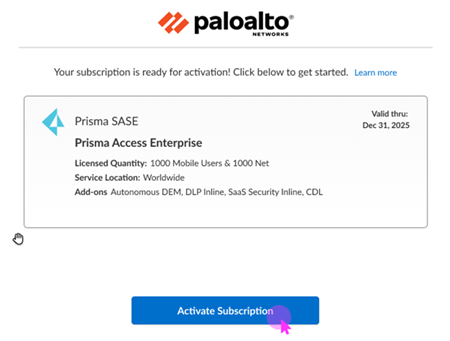
- Click Login to Activate in the welcome email.
![]()
- This will take you to the , where you can view the list of all your product entitlements. Click Activate to activate a specific product.If you don't have access to the Tenant Service Group (TSG) where your licenses are available, the Activation Console displays a Request Access option. Select Request Access to send an access request to the TSG Superusers and IAM Administrators.After reviewing your request, an administrator can assign you an appropriate role or decline the request. Once your request is approved, use the activation link in your Welcome Email again to continue activating your products.
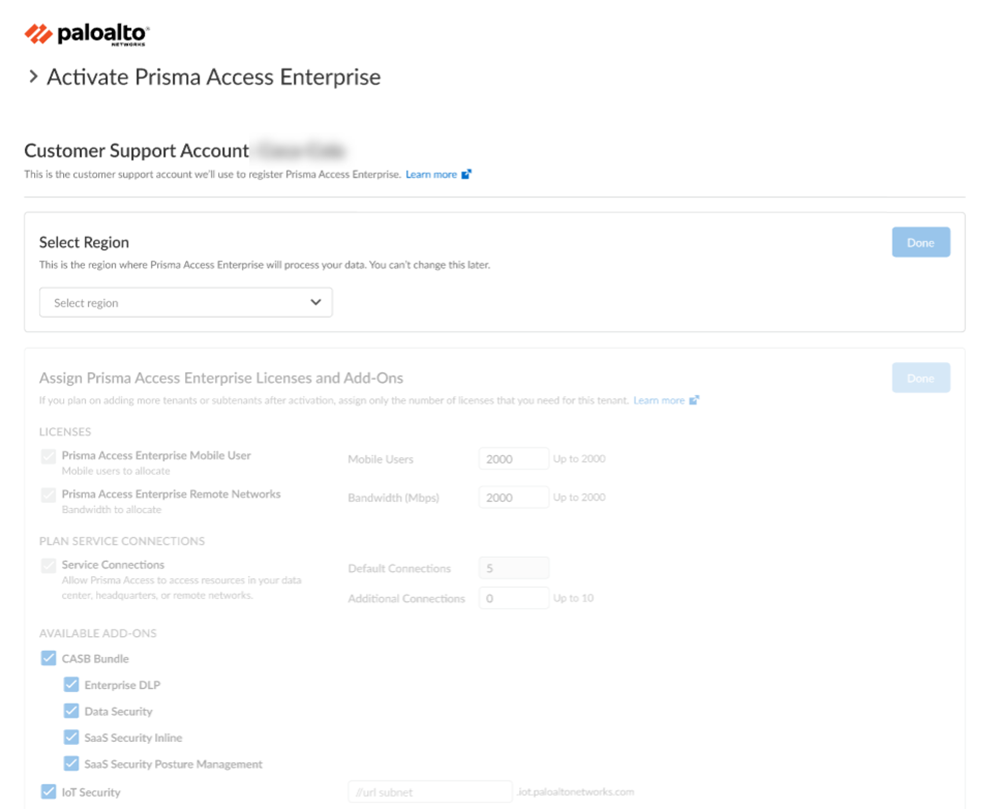
- You will be taken to the Product activation form.
![]()
- Select a Tenant if you have multiple tenants. For a single tenant environment, it is autopopulated with the primary tenant.
- Select a Region where you want to deploy your product.
- Select the product-specific details.
- Agree to the terms and conditions, and then click Activate Now.
- You will be redirected to the Subscription page, where you can see the activation status. The status column would show Activation in Progress for the products where activation is in progress.
- Once the activation is complete, click Launch to launch and access the
product.When you launch the product, you will be redirected to the Strata Cloud
Manager from where you can access the product and all its activated add-ons.
![]()


Activate a Product on Multiple Tenants
- On the Subscriptions page, locate the activated product you wish to manage.
- Click for the required product.
![]()
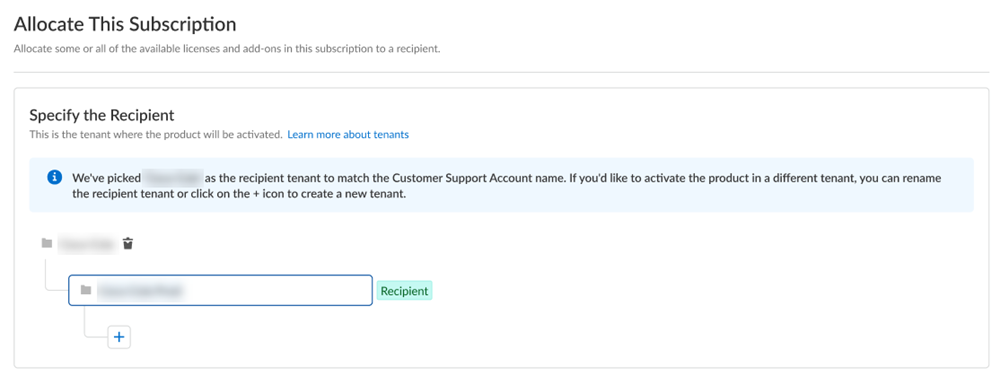
- Select the target tenant.
![]()
- Select a Region nearest to the storage location of the data logs.
- Modify the license allocation as needed.Note: If you are modifying the allocation for the default tenant, ensure that you reduce the assigned license quantity. The reduced quantity becomes available for reallocation to other tenants in the hierarchy.
- Agree to the terms and conditions, and select Activate Now to activate the license on the selected tenant.
- Validate the allocation by clicking View Details and hovering over the Tenants to view the license quantity for each tenant.
- Repeat from the Step 3 to allocate licenses to additional tenants. Validate the license allocation by switching to the corresponding tenant in the tenant browser and reviewing the allocation details.
![]()


After activating your products, you can continue to manage your subscriptions from the
Subscriptions & Add-ons page in the Activation Console. This
page provides options to perform common subscription management tasks, including
activating free add-ons, enabling purchased add-ons, reallocating licenses to other
tenants, and renewing existing licenses.